
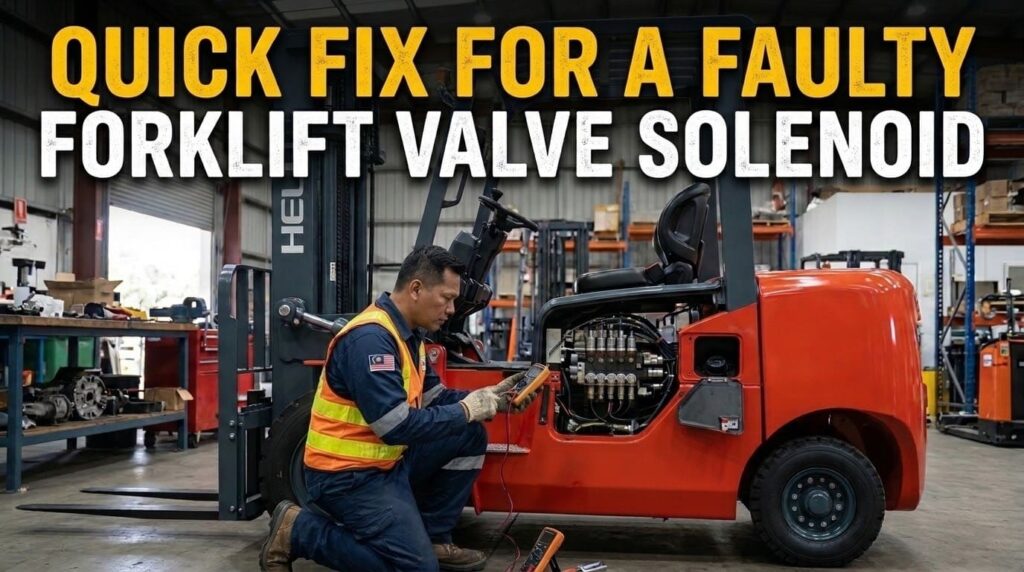
The seven valve solenoid faults that bring forklifts, electric stackers, and scissor lifts to a standstill are: coil failure to energise, coil burnout, clicks with no fluid shift, intermittent operation, valve that will not close, internal or external leakage, and persistent chattering or humming. Each fault has a distinct diagnostic signature, and knowing which you are dealing with can greatly reduce troubleshooting time.
At Avertec Sdn Bhd, our team services and supplies HELI forklifts and a broad range of material handling equipment across Malaysia. Heat, humidity, and the high duty cycles common in Malaysian logistics operations stress solenoid valves harder than most equipment catalogues acknowledge.
By the end of this article, you will understand how a solenoid valve (valve solenoid) works, recognise each fault from its symptom, carry out the core electrical and mechanical checks yourself, and know exactly what specifications to quote when ordering a replacement coil or valve body.
Key takeaways
- Coil-plunger sequence: Current through the coil creates a magnetic field that moves the plunger, which opens or blocks the hydraulic oil passage; a spring returns it when power is cut.
- NC is the safe default: Most forklift lift circuits use normally closed valves so that a power loss holds the load in place rather than dropping it.
- 24V DC is standard: Most HELI electric forklifts use 24V DC solenoid coils; always read the voltage stamped on the coil itself, not just the traction battery rating.
- Resistance test baseline: Many 24V DC coils read approximately 10–50 Ω, always compare against the coil nameplate or manufacturer’s specification, as the exact figure varies by model. An open (infinite) or shorted (near-zero) reading means the coil needs replacement.
- Seal material matters: NBR suits standard mineral hydraulic oil. For warehouses above 35°C or where hydraulic fluid contains aggressive additives, FKM (Viton) seals offer a wider temperature range and broader fluid compatibility; HNBR is another robust option for high-duty hydraulic service. Select the seal compound based on your specific fluid type, duty cycle, and peak operating temperatures, following the valve manufacturer’s recommendation.
- Genuine parts prevent repeat failures: An off-specification replacement coil or seal kit may carry the wrong voltage winding, mismatched seal compound, or an unmarked pressure rating.
What does a valve solenoid actually do in a forklift?
How an electromagnetic coil opens and closes a hydraulic circuit
A solenoid valve combines a valve body with an electromagnetic coil and a movable metal plunger. When the control signal arrives, current flows through the coil winding, which generates a magnetic field. That field pulls the plunger along its bore, uncovering the fluid passage and allowing hydraulic oil to flow to the lift cylinder, tilt cylinder, or sideshift attachment. When the signal is cut, the magnetic field collapses and a spring drives the plunger back onto its seat, blocking the passage again.
Direct-acting valves are common in walkie stacker circuits: the coil force moves the plunger directly, so they work at zero or very low system pressure. Pilot-operated valves are found in higher-flow sit-down counterbalance forklift circuits, where the coil opens a small pilot passage and line pressure then moves a diaphragm or piston to uncover the larger main orifice. This distinction matters during diagnosis because a pilot-operated valve needs a minimum pressure differential across it, typically around 0.1–0.5 bar, though this varies by valve model and must be confirmed on the valve datasheet, before it will open even if the coil is working perfectly.
Normally closed vs normally open: why it matters for safety
A normally closed (NC) valve stays shut without electrical power and opens only when the coil is energised. A normally open (NO) valve does the opposite. Most forklift lift circuits use NC valves as a fail-safe: if power is lost unexpectedly, the valve closes and the load stays at height rather than descending. Identifying whether the valve you are working on is NC or NO is the first diagnostic question to settle before anything else, because it determines what the valve should be doing in its resting state.
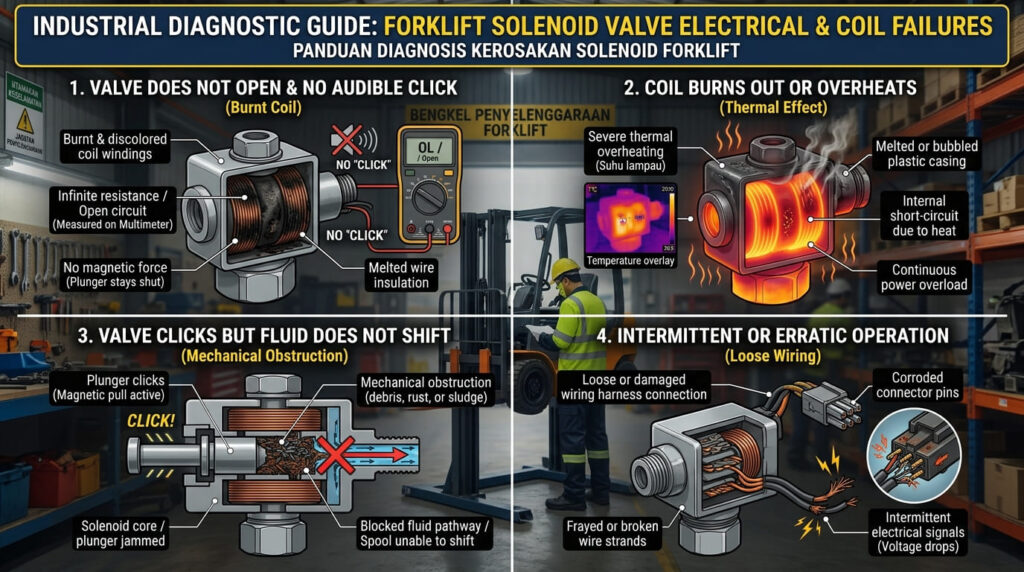
Faults 1 to 4: electrical and coil-side failures
| Fault | Key symptom | Most likely cause | First corrective step |
|---|---|---|---|
| 1. Coil fails to energise | No click, no movement | Absent signal, blown fuse, open coil winding | Measure voltage at coil terminals while commanded on |
| 2. Coil burnout | Burnt smell, coil reads near-zero Ω or open | Wrong voltage, coil removed from body while live, high ambient heat | Replace with exact coil specification; fix voltage source |
| 3. Clicks, no fluid shift | Audible click, no lift or tilt response | Low pilot pressure, blocked pilot orifice, jammed plunger | Measure system pressure under load; inspect pilot passage |
| 4. Intermittent operation | Function drops out during operation, works at rest | Loose terminal, voltage sag under load, partial contamination | Measure coil voltage under working load, not bench-tested |
| 5. Valve will not close | Load drifts, attachment creeps after de-energising | Debris on seat, broken spring, torn diaphragm | Disassemble; inspect spring, seat, and sealing parts |
| 6. Internal or external leakage | Oil weeping from fittings, or load drifts with no visible leak | Worn O-ring, degraded diaphragm, cracked body | Depressurise; replace seals or body as appropriate |
| 7. Chattering or humming | Rapid clicking or buzzing during operation | Low supply voltage, dirty armature face, sagging battery pack | Measure battery voltage under working load |
1. Valve does not open and there is no audible click
No click means no magnetic action, and the fault is almost always in the electrical path. Work through the diagnostic chain in order: confirm the control signal is reaching the valve, then measure voltage directly at the coil terminals while the valve is commanded on, then isolate power and test coil resistance with a multimeter set to Ohms. An infinite reading confirms an open winding and the coil needs replacing. A reading close to the manufacturer’s specification points you back toward the control signal, fuse, or wiring.
2. Coil burns out or overheats
In Malaysian warehouses, two conditions accelerate coil failure: a fluctuating or elevated supply voltage from an ageing battery or charger, and high ambient temperatures in poorly ventilated bays. A coil removed from its valve body while still energised will burn out within minutes because the iron core is no longer drawing heat away from the winding. Always replace a burnt coil with an exact match on voltage, AC or DC type, duty rating, and connector type. No substitution on any of those four points.
3. Valve clicks but fluid does not shift
The click confirms the coil and plunger are moving. The problem is downstream of the coil. For a pilot-operated valve, the most common cause is insufficient pressure differential: the system pressure is too low to open the main passage even though the pilot has cracked open. Measure supply pressure under load, not at idle. For direct-acting valves, the plunger may be mechanically jammed by contamination in the hydraulic oil.
4. Intermittent or erratic operation
The forklift lifts cleanly for the first hour, then the function starts dropping out. A loose connector terminal is the most frequent cause: vibration during normal operation works the terminal open under load. Test coil voltage while the machine is working at full duty, not while it is stationary on the bench. A sagging battery under heavy draw can pull the coil below its minimum holding current. At that point, the plunger oscillates rather than seating cleanly.
Faults 5 to 7: mechanical and fluid-side failures
5. Valve will not close after de-energising
The load drifts down, or the attachment keeps creeping after the operator releases the lever. The coil has de-energised correctly, but the plunger is not returning to seat. Remove the valve, disassemble it, and inspect the return spring, the valve seat, and the diaphragm or sealing disc. A broken spring is an immediate replacement; a scored seat means replacing the valve body entirely. Do not lap or sand the seat surface in an attempt to restore it.
6. Internal or external leakage
External leakage, oil weeping from fittings or the valve body, points to a loose fitting, a damaged O-ring, or a cracked body. Internal leakage, where the load drifts without any visible fluid loss, points to a worn or chemically degraded seal or a damaged diaphragm. In Malaysian warehouses, NBR seals degrade faster when exposed to biodegradable or synthetic hydraulic fluids. Always match the seal compound to the fluid type in use, and depressurise the circuit fully before disassembly.
7. Persistent chattering or humming during operation
A healthy solenoid valve makes a single clean click on energisation and then holds quietly. Rapid chattering means the plunger is oscillating because the coil cannot hold it fully seated. On DC forklift circuits, the most frequent root cause is a sagging battery pack: an ageing battery that reads 24V at rest may drop significantly under the combined draw of travel, hydraulics, and auxiliary functions. Measure battery voltage while the machine is working under load. A dirty or corroded armature face produces the same symptom and requires a careful clean with a compatible solvent on a lint-free cloth.
How do you safely inspect and test a faulty solenoid valve on-site?
Safety steps before any hands-on work
Isolate electrical power and prove dead with a meter, then depressurise the hydraulic circuit and confirm gauge pressure has returned to zero. Lock out and tag out the machine. Secure the mast or any suspended attachment against unexpected movement. Never energise a bare coil, without the iron core drawing heat away, the winding can burn out in minutes.
Valve solenoid testing with a multimeter
Isolate power, disconnect the coil connector, set the multimeter to resistance, and probe the two coil terminals. Many industrial 24V DC coils read approximately 10–50 Ω, but always compare the reading against the coil nameplate or service manual, as the exact specification varies by model. An open (OL or infinite) reading means a broken winding; a near-zero reading means a shorted winding. Either condition requires coil replacement. If the reading is correct but the valve still fails, the fault is mechanical or pressure-related, not the coil.
Using the manual override to separate electrical from mechanical faults
Many solenoid valves include a manual override button or screw on the valve body, check the valve datasheet or HELI service manual to confirm whether a specific valve has one. With the system depressurised and the load secured, activating the override should shift the valve mechanically without any electrical input. If the override works but electrical actuation does not, investigate the coil, control signal, or wiring. If the override also fails to shift the valve, the fault is mechanical inside the body itself: a jammed plunger, blocked pilot passage, damaged diaphragm, or broken spring.
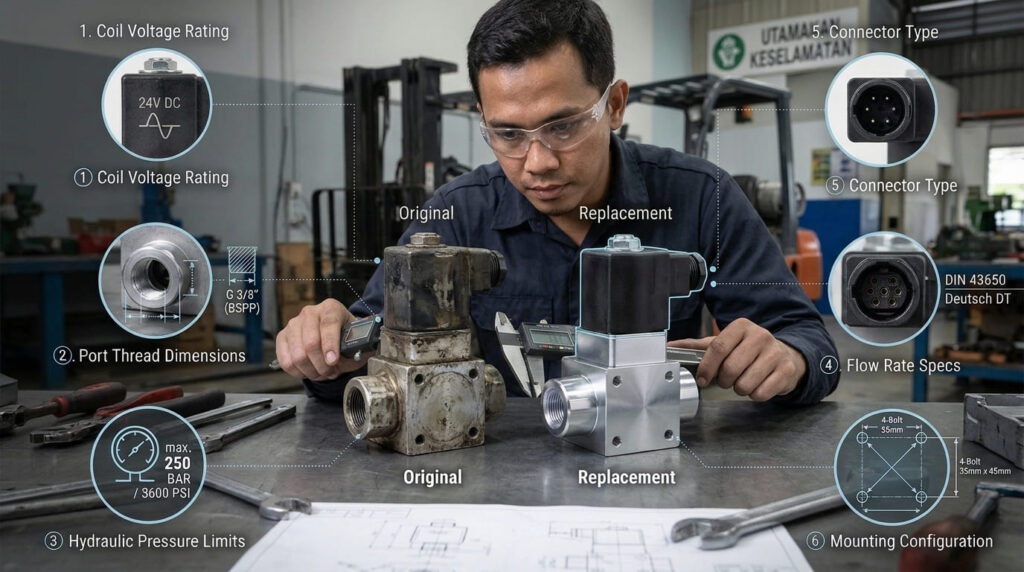
What should you check when choosing a replacement solenoid valve?
Coil voltage, port size, and pressure rating
The replacement coil must match exactly on voltage and type. 24V DC is standard on most HELI electric forklifts and walkie stackers, but some machines with 48V traction batteries use a separate regulated control voltage, so read the voltage stamped on the existing coil rather than inferring it from the battery pack. A 24V coil connected to 48V burns out quickly; a 48V coil on 24V may not shift the valve reliably. Port thread standard matters equally: G (BSPP) threads are common on European-specification valves, while NPT and metric threads appear on other brands. Size the valve using the Cv or Kv flow coefficient against the actual circuit requirements, not just by matching the pipe thread size. The pressure rating must exceed the system’s maximum working pressure with a reasonable safety margin.
Valve solenoid seal materials and IP rating for Malaysian warehouse conditions
NBR seals are the standard for mineral hydraulic oil and are adequate for moderate temperatures. For warehouses above 35°C or where the hydraulic fluid contains aggressive additives, FKM (Viton) seals offer a wider temperature range and broader fluid compatibility; HNBR is another robust option worth considering for high-duty hydraulic service. Select the seal compound based on your specific fluid type, duty cycle, and peak operating temperatures in line with the valve manufacturer’s recommendation. EPDM seals suit water-based hydraulic fluids but should not be used with petroleum-based oil. For coil protection in Malaysian warehouses with high ambient humidity and occasional washdown, IP65 is a practical minimum; IP67 is preferred for cold stores or wet environments. Always quote the original part number or valve model when sourcing a replacement: dimensional similarity is not sufficient if the pressure rating or seal material differs.
Where to source genuine solenoid valves for HELI and other MHE brands in Malaysia
Why the part number matters more than the price
An off-specification solenoid valve from a non-authorised source carries a real risk. A coil wound for a different voltage standard may be labelled as 24V DC nominal. The seal material may not match the hydraulic fluid in use. The pressure rating may be unmarked or overstated. In a worst-case scenario, a substandard valve fails under load and causes a load drop or an uncontrolled hydraulic oil release. Using a genuine replacement with the correct specifications keeps the machine within its designed safety parameters and protects warranty coverage on newer equipment.
Avertec’s genuine parts supply, installation, and emergency servicing
As Malaysia’s exclusive distributor of HELI handling equipment, we stock genuine solenoid valves, coils, seal kits, and related hydraulic spare parts for HELI forklifts, electric stackers, and scissor lifts. Our after-sales team provides on-site installation, MHE troubleshooting, and emergency replacement to minimise downtime for warehouses and manufacturing facilities across Malaysia. For non-HELI brands, please contact us to confirm whether we can assist with sourcing a compatible replacement. Get in touch with our team to confirm the right part before you order.
The diagnostic logic, applied cleanly
No click points to the electrical side: absent signal, blown fuse, loose terminal, or an open coil winding. A click with no movement points to pressure or a mechanical fault: insufficient differential pressure in a pilot-operated valve, a jammed plunger, or a blocked pilot orifice. Leakage points to seals, seats, or contamination, whether that leakage is visible at the fittings or invisible as a drifting load.
Preventive maintenance is straightforward: keep hydraulic fluid clean and filtered, inspect connectors and wiring at monthly intervals, and replace seals at the manufacturer’s recommended schedule before they fail in service. For high-duty-cycle operations, a six-monthly inspection of valve ports, plunger condition, and coil resistance provides a sensible baseline, treat OEM maintenance intervals as the primary reference, with this schedule as a guide where manufacturer data is unavailable. Condition-based replacement, guided by failure history and inspection findings, is more reliable than a fixed calendar interval.
When a valve solenoid fault does occur, the fastest resolution is a confirmed genuine replacement part matched to the original specification. Contact Avertec Sdn Bhd for genuine HELI spare parts, hydraulic seal kits, and on-site servicing across Malaysia. We carry stock and we know the equipment.
Frequently Asked Questions
How can we tell if a battery is causing chattering or humming in the solenoid valve under real working conditions?
You must measure the battery voltage while the machine is working under load to confirm this. A sagging battery pack that reads 24V at rest can drop significantly under combined travel, hydraulic and auxiliary draw, causing the coil to lose holding current and the plunger to oscillate.
Which seal material should we choose if our warehouse uses biodegradable or synthetic hydraulic fluids?
NBR seals degrade faster when exposed to biodegradable or synthetic hydraulic fluids, so you should avoid relying on standard NBR in that situation. Consider FKM (Viton) for wider fluid compatibility and higher temperatures or HNBR for high-duty hydraulic service, and always match the seal compound to your specific fluid type and the valve manufacturer’s recommendation.
If a solenoid valve has a manual override, how do we use it to separate electrical from mechanical faults safely?
Depressurise the system, secure the load, and then operate the manual override; if the valve shifts with the override but not electrically, the fault is electrical, and if the override also fails the fault is mechanical. Always confirm whether the specific valve has an override via the valve datasheet or HELI service manual, and ensure the circuit is depressurised and the load secured before attempting the override.
How do we be sure a replacement coil or valve body is the correct genuine part before ordering?
You must quote the original part number or valve model and match the coil voltage and type stamped on the existing coil rather than inferring from the battery pack. Also confirm port thread standard, Cv/Kv sizing and the correct seal compound and pressure rating, since dimensional similarity alone is not sufficient if pressure rating or seal material differs.