
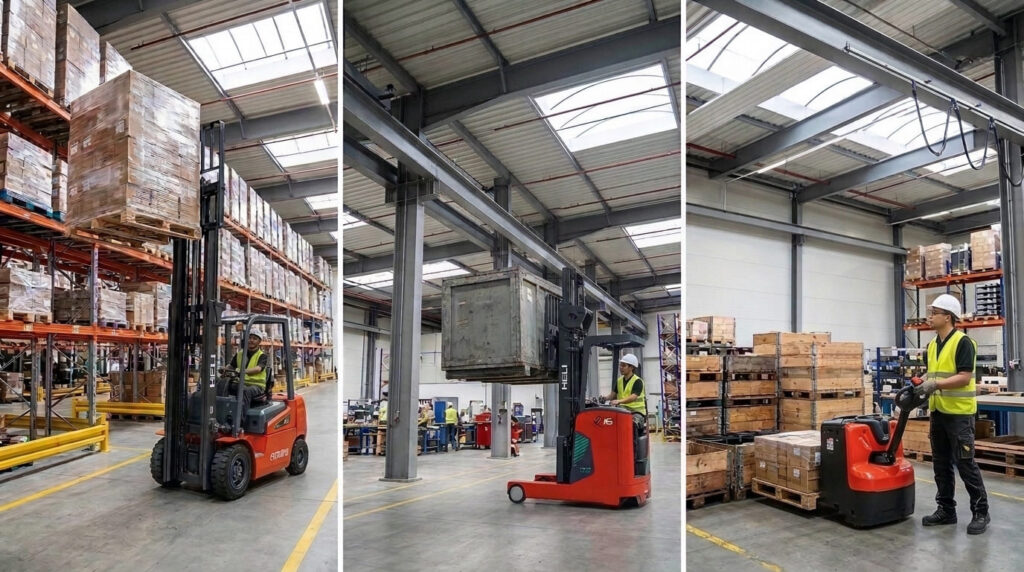
For heavy palletised loads in Kuala Lumpur, a forklift is the right starting point. Reach trucks, stackers and scissor lift tables suit specific indoor tasks, while hoists and cranes handle suspended or oversized loads. That is a different job from moving pallets.
Weight alone doesn’t decide it. Load centre, lift height, aisle width and floor conditions matter just as much, and picking by tonnage alone is how buyers end up with the wrong machine.
We’re Avertec Sdn Bhd, the exclusive distributor of HELI forklift and supplier of material handling equipment in Malaysia. We also offer forklift rental and after-sales support. Below is a plain way to match equipment to your load and your site.
Key takeaways
- Start with forklifts: They carry and stack heavy pallets. Our HELI forklifts and reach trucks together cover 1.0 to 10.0 tonnes.
- Match the task: Reach trucks suit narrow-aisle racking, stackers suit lighter pallet lifting, and scissor lifts raise loads to a working height.
- Read the load chart: Allowable capacity depends on the specific machine, mast and attachments, so check its own chart.
- Rent short, buy steady: Treat this as a starting point, then compare total rental and ownership costs.
- Know the rules: Regulated lifting machines such as cranes need DOSH registration and a valid Certificate of Fitness. Confirm what applies to your equipment.
Which equipment actually suits a heavy load: forklift, reach truck, stacker or crane?
The real split is how the load moves. Forklifts carry loads horizontally and stack them. Hoists lift vertically from a fixed support, and cranes position loads over a wider area.
Forklifts for heavy palletised loads
If your goods sit on pallets and travel across a warehouse, yard or loading bay, you want a forklift. Our HELI forklifts and reach trucks together cover 1.0 to 10.0 tonnes, including lithium battery models, for indoor and outdoor use. Check the load chart for the exact model before you commit.
Reach trucks, stackers and scissor lift tables for indoor tasks
Reach trucks work narrow-aisle racking, while walkie stackers handle lighter pallet lifting. Scissor lifts and lift tables raise loads to a working height. Each one is bound by its rated capacity and its intended use.
Where hoists, cranes and hydraulic jacks fit
Hoists lift vertically from a rated support, and cranes position loads over a wider area. Jacks raise a load a short distance for maintenance. For repeated pallet transport, a forklift is generally the better fit, though an appropriately equipped crane or hoist may move palletised loads in some circumstances.
| Equipment | Best for | Typical capacity range | Main limitation |
|---|---|---|---|
| Forklift | Moving and stacking heavy pallets | About 1 to 5 tonnes for common models | Capacity can fall with forward load centre and height |
| Reach truck | Narrow-aisle racking | About 1.5 to 2 tonnes | Indoor, level floors |
| Stacker | Lighter pallet lifting | Varies by model | Bound by rated capacity |
| Scissor lift table | Raising loads to working height | Varies by model | Lifts vertically only |
| Hoist | Controlled vertical lifting | A few hundred kg to several tonnes | Needs a rated beam or gantry |
| Crane | Suspended and oversized loads | Mobile cranes commonly 10 to 60 tonnes | Needs setup space, lift planning and qualified operation |
Ranges are broad industry examples (forklift and mobile crane figures from qdpowerful.com, reach truck figures from binhminhrental.vn), not the safe working load of a specific machine.
What should you check about your load and site before choosing?
Check six things: load weight, load centre, lift height, aisle width, ground and indoor or outdoor use. Skipping any one of them is a common way to end up with the wrong machine.
Load weight and load centre: why tonnage alone misleads
Count the pallet, packaging and any attachments in the total weight. Then read the manufacturer’s load chart, not just the nameplate figure. A forklift’s rated capacity applies only at the load centre on its data plate, so a load sitting farther from the fork face cuts effective capacity.
Lift height and clearance
Capacity can also fall at greater lift heights, depending on the machine, mast and attachments, so read the chart for your configuration. Add the height of the load itself plus landing clearance. Then check ceiling beams, lights and sprinklers, because any of them can rule out an otherwise suitable machine.
Aisle width, floor and indoor or outdoor use
Aisle width and turning radius decide between a counterbalance forklift and a reach truck. According to toyotaforklift.ca, a reach truck needs about 2.4 to 3.0 metres of clear aisle, while a counterbalance forklift needs about 3.4 to 4.0 metres. Always use the manufacturer’s stated aisle figure for your model.
Forklifts need firm, level surfaces unless the machine is rated otherwise, and your floor loading limits still apply. Indoor use often favours electric and lithium models. For outdoor yards and uneven ground, fuel type is not the test: check that the model and its tyres are rated for your site’s terrain and ground conditions.
Write these down before you talk to any supplier:
- Load weight, including pallet and packaging
- Load centre
- Lift height, including landing clearance
- Aisle width and turning space
- Floor type and loading limit
- Indoor or outdoor use
Is it better to rent or buy heavy lifting equipment?
Rent when the need is short or uncertain, and consider buying when use is daily and steady. Compare total rental and ownership costs: buying is more likely to pay off at high utilisation over about three years or more.
When renting makes more sense
Rental suits short projects, seasonal peaks, a trial before committing, and sites with unclear long-term needs. Construction and industrial teams that need a forklift for weeks, not years, shouldn’t tie up money in a machine they’ll park afterwards.
When buying wins
Daily, multi-shift use and stable workloads spread the ownership cost out. In that case, consider buying new or pre-owned equipment backed by genuine spare parts and local servicing.
How Avertec handles both options
We offer short-term and long-term forklift rental, new and pre-owned equipment, and after-sales servicing, all from one supplier. Rental is also a practical way to test whether a machine fits your aisles before you buy.
What safety and capacity rules apply in Malaysia?
Rated capacity is the ceiling, and regulated lifting machines such as cranes carry legal requirements on top of that. Whether a particular forklift or other piece of MHE is regulated depends on its classification, so confirm it against current DOSH rules.
Rated capacity is the ceiling, every time
Use the manufacturer-rated safe working load. Never exceed it at height or at an extended load centre. Don’t use a forklift for suspended loads without approved attachments.
DOSH requirements for regulated lifting machines
According to DOSH, a crane or other regulated lifting machine must be registered with DOSH (JKKP) and hold a valid Certificate of Fitness before use. Periodic inspection is also required, at intervals of no more than 15 months. You also need competent operators, a risk assessment and a lift plan. Requirements differ by equipment type, so check your equipment against current guidance on the DOSH (JKKP) website.
Inspection, rigging and operators
Run daily pre-use checks. Slings, shackles and hooks must be rated to their working load limit, and the weakest component sets the limit for the whole assembly. Sling angles and configuration also change the forces on each component, so check the ratings for your actual setup. Keep inspection and maintenance records, and keep people out from under suspended loads.
What should you tell a supplier in the Klang Valley before asking for a quote?
Give the supplier your load, your space and your usage pattern. That information helps them recommend a suitable machine.
The information that gets you the right machine
- Load weight, load dimensions and load centre
- Lift height, aisle width, and door and ceiling clearances
- Floor type, and indoor or outdoor use
- Shift pattern, power preference, and whether you want to rent or buy
Take a typical case: a Klang Valley warehouse stacking 1.5-tonne pallets into racking in a narrow aisle. The load weight, the load centre on those pallets, the top beam height and the clear aisle width together point towards a reach truck rather than a counterbalance forklift. A supplier still needs those figures confirmed before naming a model, because the load chart for that specific machine has the final say.
Why a supplier with servicing and spare parts matters
Downtime can cost more than the price difference between machines, depending on your operation and equipment. Avertec stocks over fifty types of MHE and supplies genuine spare parts. We also offer troubleshooting and servicing.
Questions to ask any supplier
Ask whether the stated capacity applies at your actual load centre and lift height. Ask about after-sales response time, whether rental units are serviced, and whether parts are in stock locally. You are welcome to send us your checklist when you enquire.
Pick the machine for the job, not the biggest number on the spec sheet
For moving heavy loads around KL, the answer is forklifts for heavy palletised loads. Reach trucks, stackers or scissor lift tables handle specific indoor tasks. Load centre, lift height, aisle width, ground and indoor or outdoor use decide the final pick.
Rent when the need is short or uncertain, and buy when use is steady and daily.
Get in touch with Avertec Sdn Bhd for HELI forklifts, rentals and after-sales support for heavy load lifting in Kuala Lumpur and across Malaysia.