
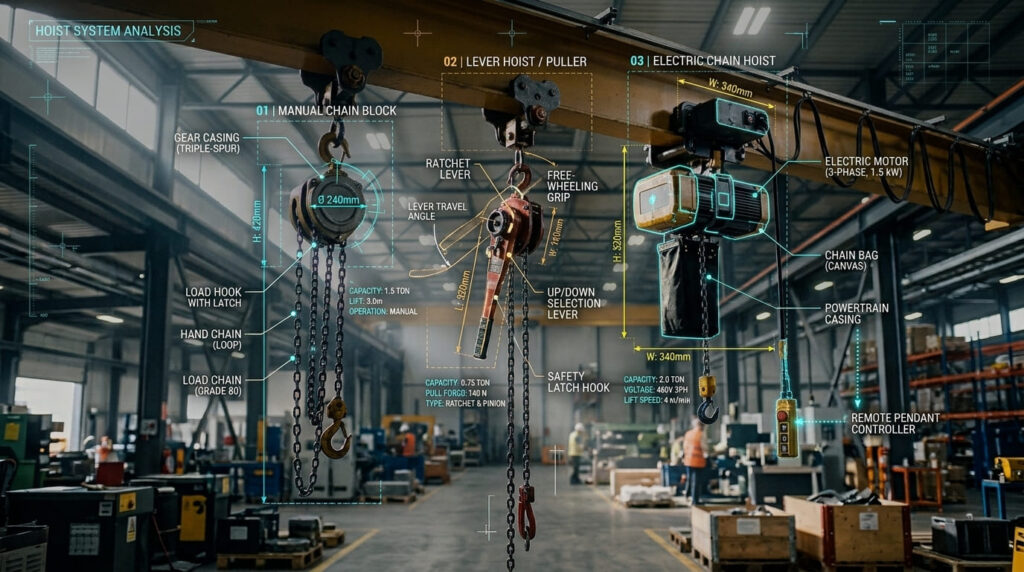
For many occasional or light-to-moderate overhead lifts in a Malaysian warehouse or factory, a manual chain block is often the most practical and cost-effective choice, particularly when duty-cycle guidance confirms lifts are infrequent and controlled. A lever hoist is the right call for angled pulls, tensioning work or confined spaces. An electric chain hoist only justifies the extra outlay when operators are lifting repeatedly, all day, every shift.
This article covers how each type works, which suits which application, how to size one correctly for load and lift height, what compliance documents to verify before purchasing in Malaysia, and how to inspect and maintain a unit properly.
Key takeaways
- Manual chain block: Best for controlled overhead vertical lifts; capacities from 1 t to 5 t with 3 m as the standard lift height.
- Lever hoist: Choose this for angled pulls, tensioning, alignment work or any situation with restricted headroom.
- Electric chain hoist: Justified when lifting is repetitive across full shifts; requires a power supply and DOSH design verification plus a Certificate of Fitness.
- Compliance: Manual hoists generally do not require DOSH/JKKP registration, but power-driven hoists do. Always request proof-load test certificates.
- Inspection: Run a pre-use check before every single lift; schedule a formal documented inspection at least annually.
What are the three main types of chain block?
All three are forms of chain hoist that use a load-bearing chain and a braking mechanism to lift or lower a load safely. The key differences are in how the operator inputs force and what duty cycle the unit can handle.
Manual chain block: the go-to for straightforward overhead lifting
The operator pulls a continuous hand chain, which drives gearing and a load sheave while a friction brake holds the load between pulls. Standard capacities in Malaysia run from 1 t to 5 t, with 3 m as the most common standard lift and 5 m widely available. You may also hear these called a chain pulley block or chain fall: these are regional names for the same tool, not separate products.
Lever block: compact, directional and suited to tight spaces
A lever block uses a ratchet lever mechanism with a selector that switches between lift, lower and free-chain modes. Its critical advantage over a manual chain block is direction: a lever block can be used for horizontal pulls, tensioning and angled positioning when the manufacturer’s rating permits, whereas a hand chain hoist is designed primarily for vertical lifting. The shorter stroke per cycle also means it needs less headroom, which matters in plant rooms and underneath loaded vehicles.
Electric chain hoist: speed for high-frequency operations
A motorised hoist eliminates operator fatigue on repetitive lifts, making it the right tool for production line work, overhead crane systems and busy logistics docks where manual lifting would slow the operation down. The trade-offs are real: the upfront cost is significantly higher than a manual unit, a power supply is required, and power-driven hoists carry regulatory obligations that manual hoists do not.
| Criteria | Manual chain block | Lever block | Electric chain hoist |
|---|---|---|---|
| Operation method | Continuous hand chain | Ratchet lever, short strokes | Electric motor, pendant control |
| Direction of use | Primarily vertical lifting; side or angled use only if explicitly permitted by the manufacturer | Vertical, horizontal, angled (where rated) | Vertical lifting |
| Typical capacity range | 1 t to 5 t | 1 t to 5 t | 1 t to 5 t (and beyond) |
| Standard lift height | 3 m; 5 m widely available | Commonly used for short-stroke lifts; available chain lengths vary by manufacturer, confirm options with your supplier | 6 m to 12 m typical |
| Headroom requirement | Moderate | Lower | Higher (motor housing) |
| Approx. price range (Malaysia, indicative) | RM250 to RM900+ | RM190 to RM1,000+ | RM400 to RM30,000+ depending on grade |
Which type fits your Malaysian operation?
The right choice becomes obvious once you map it to your actual working environment rather than a generic spec sheet. In a warehouse or logistics centre, a manual hoist handles occasional, controlled vertical lifts well: hanging machinery for maintenance, shifting container freight without a forklift, or positioning a heavy item onto a racking system. If your distribution hub runs multiple lifts per hour across multiple shifts, that workload pushes the economics firmly towards an electric hoist.
On a factory floor, lever blocks are the tool of choice for pulling, aligning and positioning heavy machinery components, particularly when the load needs to move at an angle or the operator cannot stand directly below it. Manual hoists suspended from monorail beams handle mould tools, engine blocks and similar items effectively. When maintenance work is daily rather than weekly, pay close attention to duty class: a standard manual block used at daily frequency will wear out prematurely.
On construction sites and in confined plant rooms, lever blocks are valuable precisely because of their lower headroom requirement. Malaysia’s heat, humidity and outdoor exposure accelerate corrosion on load chains, so inspection and lubrication intervals should be shortened for site-based equipment compared with indoor warehouse use.
How do you match capacity and chain length to your lift?
Never select a hoist at its rated limit without accounting for sling angles and dynamic loading. The working load limit (WLL) is not the breaking strength: it is the maximum load the unit may carry under correct operating conditions. If your load is close to a capacity boundary, choose the next size up. A practical guide: a 1 t block suits workshop maintenance and light assembly work; a 3 t to 5 t unit is appropriate for machinery and structural steel on a factory floor.
Lift height is usable vertical travel, not chain length. With a 3 m standard chain and typical hook-to-hook dimensions, effective lift is often meaningfully less than 3 m. Before specifying chain length, measure beam height, hook clearance and the height of the load in its rigged position. Five-metre and 6 m chains are readily available in Malaysia, so longer beams are not a barrier to using a manual unit.
Duty cycle is the selection criterion most operations overlook. A unit classified for occasional or light duty will wear its brake, gears and load chain prematurely if used for many lifts per shift. Mounting arrangement also changes the application significantly: a hook-suspended block stays fixed above one point, a push-travel trolley lets the operator slide the load along a beam manually, and a motorised trolley handles frequent travel on longer runs.
What compliance documents should you request before buying in Malaysia?
The DOSH/JKKP position on manual hoists is clearer than many buyers expect. A conventional hand-operated chain block or manual lever hoist generally does not require JKKP design verification or a Certificate of Fitness. DOSH expressly excludes manually operated lifting machinery from the Certificate of Fitness requirement.
However, any hoist that uses an electric motor, air supply or other power drive is classified as power-driven lifting machinery and must obtain DOSH design verification before installation and a valid Certificate of Fitness before operation. Applications are submitted through the MySKUD system via MyKKP. If you are unsure whether your specific installation is classified as manual or power-driven, confirm with the relevant JKKP state office before purchasing.
For documentation, request the following regardless of hoist type. A proof-load and functional test certificate should identify the manufacturer, model, serial number, rated capacity, test load, test date, test method, inspector and result. Consider restructuring this information as a checklist when filing it:
- Manufacturer name and model
- Serial number
- Rated capacity and test load
- Test date and test method
- Inspector name and result
If a supplier claims SIRIM certification, ask for the certificate number and verify it directly with SIRIM QAS: a genuine product certificate identifies the certificate holder, manufacturer, product range, applicable standard and validity. Do not accept “ISO certified” as evidence of product safety; ISO 9001 certifies a management system, not the lifting capacity or structural integrity of the hoist itself. CE marking is a European market requirement, not a Malaysian regulatory one.
Red flags that should stop a purchase:
- “CE/SIRIM approved” with no certificate number
- A test report that covers a different model or capacity from the unit being sold.
- A QR code that cannot be verified against a named issuing body.
- A supplier unwilling to allow DOSH/JKKP or SIRIM to confirm the documentation
The price reflects the risk, not a good deal.
Inspection checklist: what to check before every lift
A pre-use check is not the same as a formal periodic inspection. It is a visual and functional sanity check that every operator should run before attaching any load. Work through this sequence before each lift:
- Confirm the rated capacity, identification tag and inspection status are legible. Do not use any unit tagged out or with an unknown capacity.
- Check the suspension point: beam, trolley, clamp or structure must be approved for the load and correctly aligned.
- Inspect the body for cracks, distortion, impact damage, corrosion or missing covers.
- Inspect both hooks for cracks, bending, excessive throat opening and confirm each safety latch closes fully.
- Examine the load chain for stretched, bent, twisted, corroded or stiff links.
- Check the hand chain runs freely through the hand wheel without kinks or damaged links.
- Test unloaded operation: raise and lower through a short travel and listen for grinding, catching or binding.
- Test the brake with a controlled unloaded cycle: the mechanism must hold without drifting.
- Confirm the load is within capacity, correctly rigged and clear of obstructions.
- If anything is wrong, tag the unit out of service. Do not attempt on-site repairs to chains, hooks or brakes.
Beyond the pre-use check, schedule a competent-person inspection monthly for regular-use equipment, and a thorough documented inspection at least annually, every six months for heavy or severe service. After a shock load, overload, dropped load, long storage or repair, remove the unit from service and have it examined before reuse. The five failure modes to know are: load-chain elongation or damage, hook bending or throat opening, brake slipping or contamination, worn sheave pockets causing chain jump, and hand-chain kinks or damaged links.
Where to source certified hoists and genuine spares in Malaysia
The practical difference between buying from an established material handling equipment distributor and buying from a marketplace listing comes down to what happens after the sale. A reliable local supplier can provide full compliance documentation, supply genuine spare parts matched to the exact manufacturer, model and chain size, offer after-sales servicing and scheduled maintenance, and give pre-sale advice on capacity, duty class and mounting.
Avertec Sdn Bhd is a Malaysian distributor of material handling equipment offering after-sales service and spare parts support. Contact our team to confirm current stock, obtain a compliance-ready specification for your application, or arrange a site assessment before you buy.
The right hoist for your operation
The correct choice is determined by three things: the direction and frequency of your lifts, the load you need to handle, and the compliance standard your site requires. A manual chain block covers most overhead lifting needs efficiently and at low cost. A lever block adds flexibility for maintenance work, confined spaces and angled positioning. An electric chain hoist makes sense when manual fatigue is a real productivity drag across full daily shifts.
The cheapest listing on a marketplace is not the safest option when loads are suspended over people or valuable equipment. Buy from a supplier who can back the unit with documentation, genuine spares and service after the sale.
If you are sourcing hoists in Malaysia and need correct compliance documentation alongside local after-sales support, Avertec Sdn Bhd is equipped to help. Contact us and we will make sure you get the right unit for your load, your beam and your operation.
Frequently Asked Questions
Do manual chain blocks need DOSH/JKKP registration in Malaysia?
No, conventional hand-operated chain blocks and manual lever hoists generally do not require DOSH/JKKP registration or a Certificate of Fitness. We note that DOSH expressly excludes manually operated lifting machinery from the Certificate of Fitness requirement, but any power-driven hoist will need DOSH design verification and a valid Certificate of Fitness before operation.
What are the typical price ranges for manual, lever and electric hoists in Malaysia?
Typical indicative price ranges in Malaysia are RM250 to RM900+ for manual chain blocks, RM190 to RM1,000+ for lever blocks, and RM400 to RM30,000+ for electric chain hoists depending on grade. We emphasise that price reflects risk as much as cost, and buying from a supplier who can provide documentation, genuine spares and after-sales service is important.