
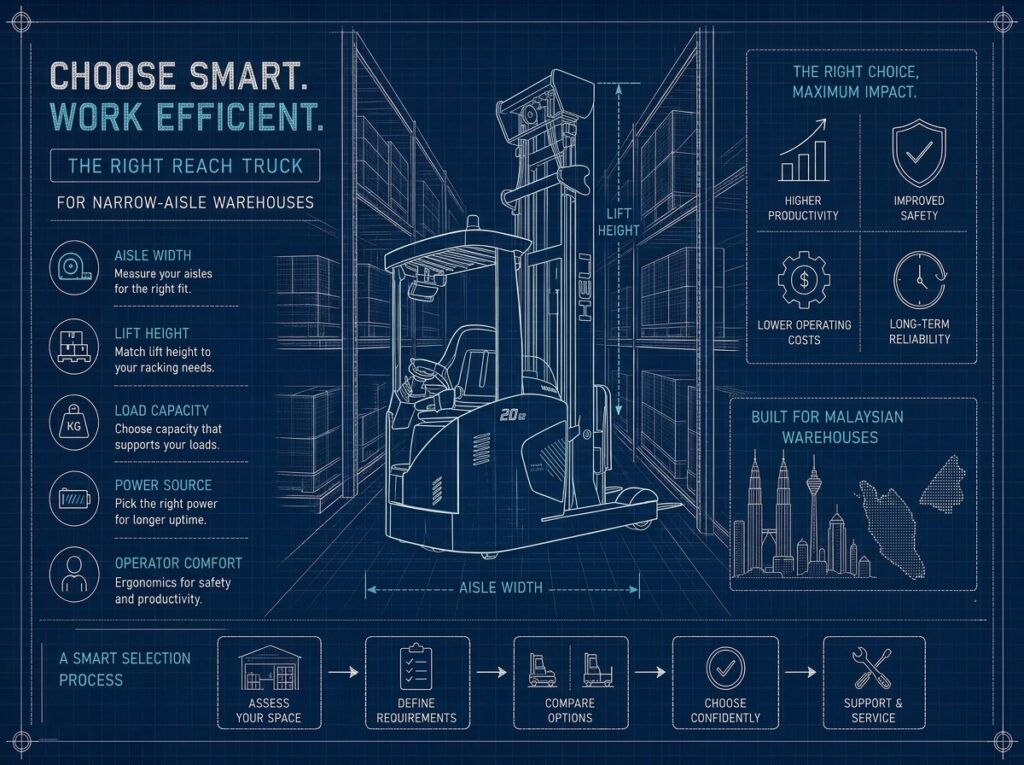
Most Malaysian warehouses are leaving storage capacity on the table, and in many cases, a reach truck is the piece of equipment that would recover it. Counterbalance forklifts are the default choice. They work. But they need roughly 3.5 to 4.3 m to turn comfortably, and in a warehouse designed around narrower aisles, that turning radius quietly consumes pallet positions that should be earning their keep.
A reach truck solves this by using a retracting mast or pantograph mechanism to extend the forks into racking, pull the load back over the wheelbase, and travel in aisles as narrow as 2.3 to 3.0 m. The operational difference is substantial. The problem is that most warehouse managers only recognise this after the fact, when throughput has dropped and aisle congestion has become a daily headache, measured in extra travel time and missed pick targets.
In our experience working with warehouse managers over more than a decade, the wrong equipment decision rarely shows up on day one. It tends to surface several months later, when pallet count has grown, SKU variety has increased, and the aisle layout is visibly eating storage capacity. This guide covers the main types of narrow-aisle truck, the specifications that drive the selection decision, how buying compares to renting in Malaysia, and what safety compliance actually requires.
What a reach truck is and how it differs from a standard forklift
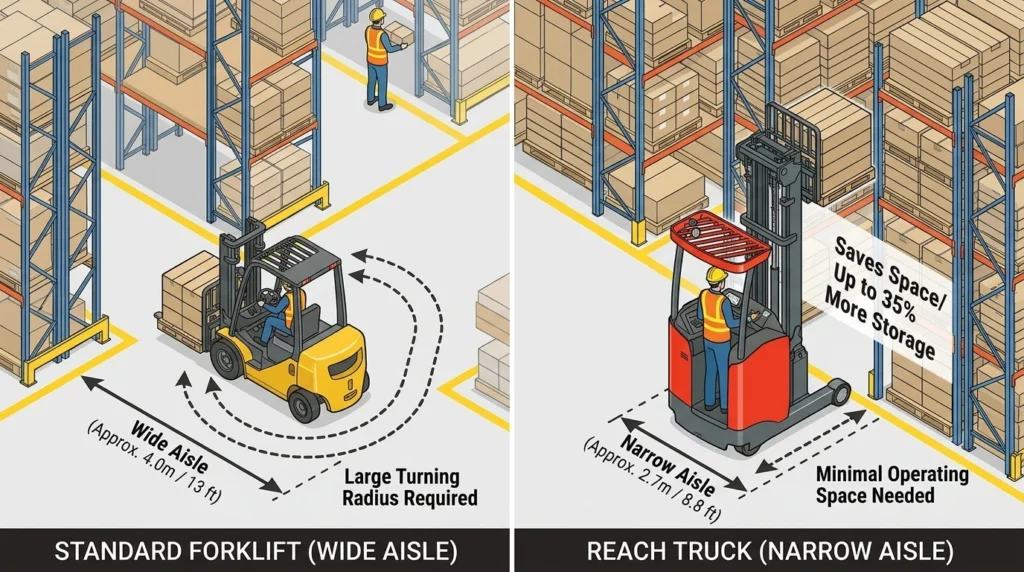
The fundamental difference is how each machine supports its load. A counterbalance forklift carries the load cantilevered in front, balanced by a heavy rear counterweight. That counterweight adds bulk, and the truck needs space to swing around it. A reach truck uses front outrigger legs and battery weight to support the load, combined with a mechanism that retracts the load back over the wheelbase. The truck footprint is smaller, and the turning radius is dramatically reduced.
A very narrow aisle (VNA) turret truck takes this further, operating in aisles of 1.8 to 2.2 m with a rotating fork head that services racks on both sides without the truck turning at all. But VNA equipment requires purpose-built infrastructure: very flat floors, guided aisle systems, and specially engineered racking. It is not a drop-in upgrade for an existing warehouse.
How the reach mechanism changes your aisle requirements
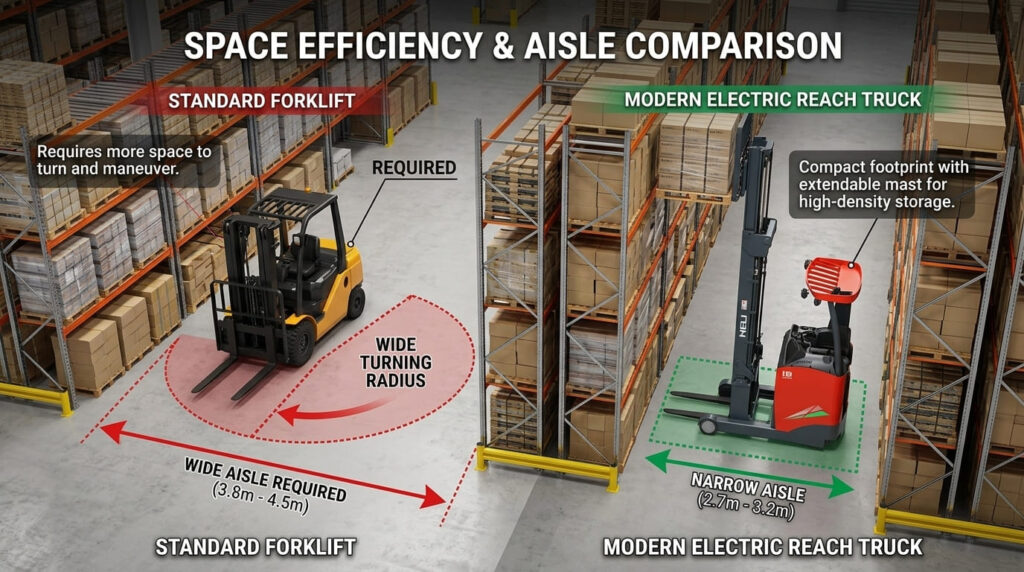
Because the load retracts back over the wheelbase, the machine does not need the same turning radius as a counterbalance forklift. Standard single-reach models operate in aisles of 2.6 to 2.9 m, a meaningful reduction from the counterbalance forklift’s 3.5 to 4.3 m requirement. In practical terms, that difference allows narrower aisle spacing across the facility, which can translate to additional pallet positions without any structural changes. The exact gains depend on your bay dimensions, aisle count, and pallet geometry, so model the numbers for your specific floor plan rather than applying a blanket estimate.
When a reach truck is the right call (and when it isn’t)
A reach truck is designed for indoor, high-rack, narrow-aisle pallet storage. It handles smooth, level floors and selective or double-deep racking well. It is not suited to loading docks, outdoor yards, uneven surfaces, or any operation that crosses between indoor and outdoor environments. For mixed workflows, you still need a counterbalance forklift alongside it. No single machine does everything, and trying to make one do so creates operational problems faster than any equipment shortage will.
Reach truck buying guide: main types for narrow-aisle warehouses in Malaysia
Malaysian warehouses can access four main configurations: stand-up, straddle (sit-down), double-deep, and turret. The decision is not about which type sounds most advanced. It is about matching the truck to your racking layout, pallet dimensions, SKU count, and floor quality. For most distribution, FMCG, and e-commerce operations in Malaysia, the stand-up single-reach truck covers the large majority of day-to-day requirements.
Stand-up and sit-down (straddle) configurations
Stand-up reach trucks are compact, manoeuvrable, and well-suited to frequent put-away and retrieval in single-deep selective racking. The operator steps on and off quickly, which matters in high-cycle environments. Sit-down straddle variants offer better stability for wide or heavy pallets and reduce operator fatigue over long shifts. The aisle requirements are similar between the two, but the practical choice depends on your pallet geometry and the structure of your shifts.
Double-deep reach for higher storage density
Double-deep trucks use telescopic forks to reach the second pallet position behind the front pallet, reducing the number of access aisles in a given floor area. The trade-off is selectivity: you normally must remove the front pallet to retrieve the rear one. This suits high-volume, low-SKU operations such as beverages, commodities, and seasonal goods, where last-in, first-out (LIFO) rotation is acceptable. If your operation demands strict FIFO or manages a wide variety of SKUs, double-deep is the wrong choice regardless of the density gains.
Turret trucks: only for purpose-built warehouses
Turret trucks maximise cube utilisation in aisles as narrow as 1.8 to 2.2 m. The economics can be compelling for high-bay, high-density storage, but the infrastructure requirements are substantial: ultra-flat floors, guided aisle systems, purpose-engineered racking, and significant capital investment. These are not a retrofit option for an existing Malaysian warehouse. Approach turret equipment only for new high-bay builds where the storage density gains clearly justify the full infrastructure cost.
The specifications Malaysian warehouse managers must prioritise
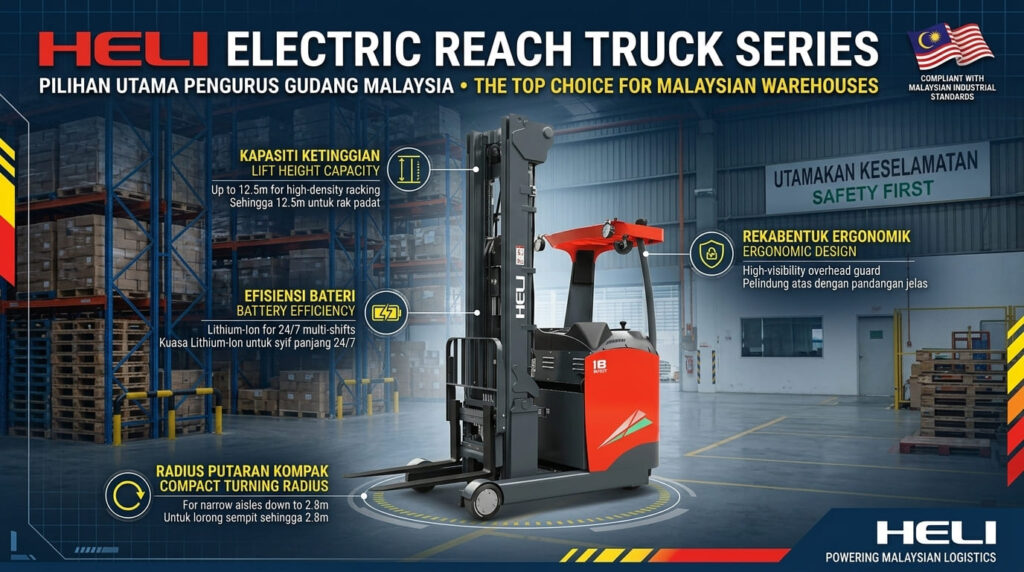
Once you have identified the right type, the decision narrows to three numbers: lift height, aisle width, and load capacity. Battery type is the fourth, and in Malaysia’s climate it carries more weight than most buyers account for at the purchasing stage.
Lift height and aisle width compatibility
Standard single-reach trucks lift 6 to 9.5 m and operate in aisles of 2.6 to 2.9 m. Double-deep units reach 8 to 12 m in roughly 2.7 to 3.0 m aisles. Note that 2.3 to 3.0 m is an overall planning range across reach truck types; the 2.6 to 2.9 m figure applies specifically to typical single-reach models. The critical point is to measure your actual clear aisle width, including rack guards, sprinkler protrusions, and pallet overhang, not the nominal rack spacing. A planning value of 2.8 m clear is a reasonable starting point, but the final design must use the manufacturer’s right-angle stacking dimension for the exact truck and pallet combination you are running. Published aisle figures are model-specific and load-specific.
Load capacity and load centre
Most reach trucks handle 1.0 to 2.5 tonnes, but rated capacity drops meaningfully at greater lift heights and extended reach positions. A truck rated at 1.6 tonnes at ground level may carry significantly less at 9 m. Always request the capacity data plate figures for your specific combination of mast height, reach extension, and load centre before settling on a model. This step is non-negotiable. Missing it creates safety risks and throughput limitations that no amount of operator training can compensate for.
Battery options: lead-acid versus lithium in Malaysian conditions
Lithium-ion batteries recharge faster, tolerate opportunity charging between shifts, and perform more reliably in high-heat environments. For a warehouse running two or more shifts, lithium is worth the higher upfront cost. Lead-acid remains viable for single-shift operations with dedicated charging rooms, but the battery room ventilation and ongoing maintenance requirements add overhead that purchasers consistently underestimate at the buying stage.
Buying versus renting a reach truck: the honest comparison for Malaysian operations
Neither option is universally better. The right answer depends on your utilisation rate, cash flow position, and how stable your warehouse requirements are over the next three to five years.
A new electric reach truck in Malaysia is priced at approximately RM159,600 based on current supplier pricing. Reconditioned units from reputable suppliers vary widely, expect to pay anywhere from RM50,000 to RM100,000 for units in good condition with reasonable hours and serviceable battery health, though older or higher-hour units may be available at lower price points. Buying makes sense when you have consistent, multi-shift utilisation and a servicing arrangement in place to protect the asset over the long term.
Rental rates for a 1.2 to 1.6-tonne electric reach truck run approximately RM2,000 to RM2,700 per month. Lithium units in the 1.5 to 2.5-tonne range sit around RM2,500 per month. Reach truck rental in Malaysia makes particular sense for businesses setting up a new distribution centre and testing their workflow before deploying capital, companies with seasonal volume peaks, or SMEs that cannot absorb a large equipment purchase without affecting working capital.
The key question for any rental agreement is what is actually included. A low monthly rate that excludes servicing, battery care, and a replacement truck during downtime can end up costing more than a full-service package at a higher headline figure. Before signing, confirm battery type, mast height, included service intervals, breakdown response time, replacement unit provision, and damage liability terms.
Safety compliance and maintenance that Malaysian operators cannot skip
A reach truck is a high-lift machine operating in confined spaces alongside pedestrians and racking. The consequences of poor compliance are serious. In Malaysia, the legal framework sits under the Occupational Safety and Health Act 1994 (Act 514), enforced by DOSH/JKKP. Every employer running this type of equipment needs to understand both the training requirements and the day-to-day inspection discipline.
DOSH requirements and operator training
Operator training must be specific to the reach truck. A counterbalance forklift certificate does not qualify a person to operate one. Training covers pre-use inspection, load handling, stacking at height, warehouse manoeuvring, and emergency procedures, followed by written and practical assessment. Training certificates commonly carry a three-year validity; refresher training is required after incidents, extended absences, or equipment changes. The employer must authorise only trained and competent operators and maintain records of training, authorisation, inspections, and maintenance.
Pre-shift inspections and site traffic management
Every shift should begin with a documented pre-use inspection: forks, mast, chains, hydraulics, battery, brakes, steering, horn, and emergency isolation. Industry practice typically sets speed limits at 5 km/h in pedestrian areas, though employers must establish site-specific limits based on layout and risk assessment. A written traffic management plan covering pedestrian segregation, one-way systems, and restricted zones is an employer duty under OSHA 1994. These are not recommendations.
Servicing schedules and spare-parts availability
Planned servicing follows operating hours, with professional inspections recommended at roughly 250 to 500-hour intervals. The practical risk in Malaysia is parts availability and response time. Before committing to any brand or model, confirm that the local supplier holds genuine spare parts inventory and can provide technician coverage within a defined response time. This single factor often matters more than a marginal difference in initial equipment price, particularly for operations where every hour of downtime has a direct cost.
How a Malaysian distribution centre solved its narrow-aisle problem with Avertec
A regional distribution centre in the Klang Valley was running counterbalance forklifts in a warehouse originally designed for them. As SKU count grew and pallet positions became scarce, the pressure to increase storage density without relocating became urgent. The facility had clear aisles of 2.7 m and racking that could support heights up to 10 m. The counterbalance forklifts in use needed 3.8 m to turn comfortably, which meant several bays were effectively dead space. Converting to narrow-aisle reach trucks would recover those aisles and, based on the facility’s bay layout and aisle count, was projected to add approximately 25 to 30 per cent more pallet positions without any structural changes to the building.
Avertec Sdn Bhd, as the exclusive HELI handling equipment distributor in Malaysia, supplied a fleet of HELI electric reach trucks matched to the site’s aisle dimensions and racking height. The facility started with a rental arrangement to validate throughput before committing to a full purchase, a practical approach that produced measurable results: pallet position utilisation improved materially within the first quarter of operation, and the rental-to-purchase pathway gave the distribution centre operational certainty before capital deployment.
Avertec backs its reach truck supply with genuine HELI spare parts, scheduled maintenance packages, and on-site troubleshooting. For operations where downtime has a direct cost, local technical support and parts inventory matter as much as the equipment specification itself.
Choosing the right reach truck: three questions that matter
The starting point is your aisle and racking geometry, what the space actually permits. From there, your utilisation rate and cash flow determine whether buying or renting makes more sense. The third question is support: who will service the equipment, hold parts locally, and respond when something goes wrong? A reach truck is a precise tool for a specific application, not a universal upgrade.
Get the application right and the efficiency gains are real. Get it wrong and you have an expensive machine that does not fit your workflow. Use the type guidance and specification ranges in this article as a starting point, measure your own warehouse rather than relying on brochure figures, and work with a supplier who can match equipment to your actual conditions rather than their fastest-moving model.