
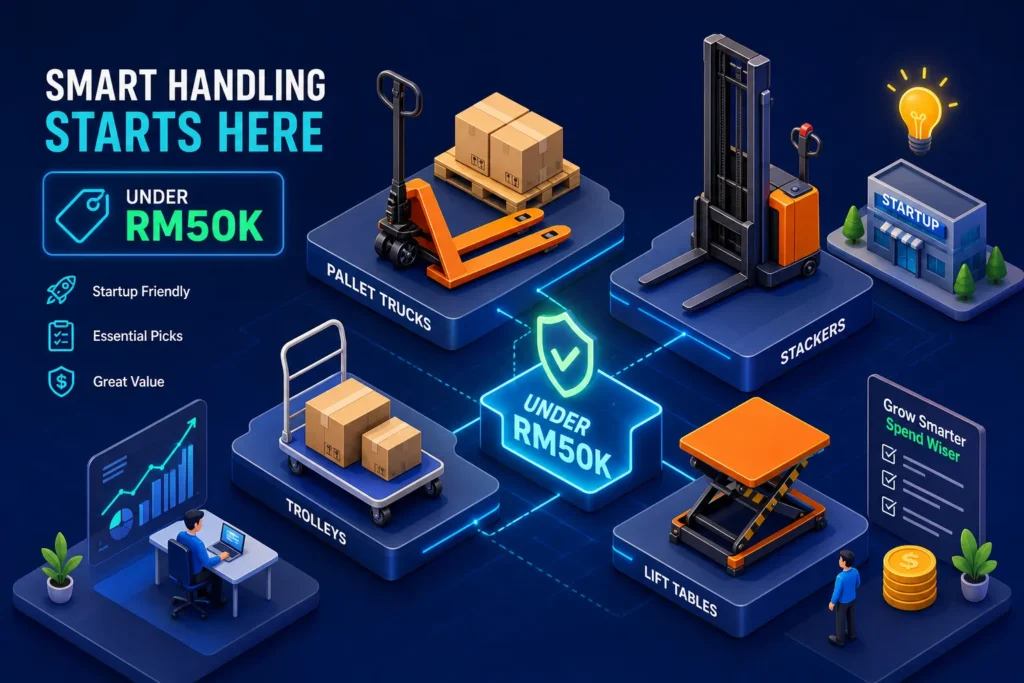
RM50,000 is a serious amount of money for a startup factory, but it disappears faster than you expect when you buy the wrong equipment. A sit-down forklift that needs a 4-metre aisle installed into a factory with 3-metre aisles is not an asset; it is an expensive problem sitting in the corner. Malaysian startup operations face a specific version of this challenge: Avertec’s public spec pages do not publish standardised duty-cycle or price lists, equipment categories are numerous, and advice is rarely tailored to your floor conditions, pallet type, or shift pattern.
This guide draws on the product range and planning context from Avertec Sdn Bhd, a Klang-based direct importer and exclusive distributor of HELI material handling equipment (MHE) in Malaysia. Rather than working through a catalogue, this article walks through a structured framework for comparing Avertec material-handling options within a RM50,000 budget: understand your site first, then match the right equipment category to your actual workflows, then decide whether to buy new, rent, or buy pre-owned. One thing this article will not do is give you hard prices. Configurations vary, sites vary, and any figure that is not tied to your specific model and site requirements is unreliable. A formal quote from Avertec is the only number worth acting on.
What your factory floor must tell you before you commit to any equipment
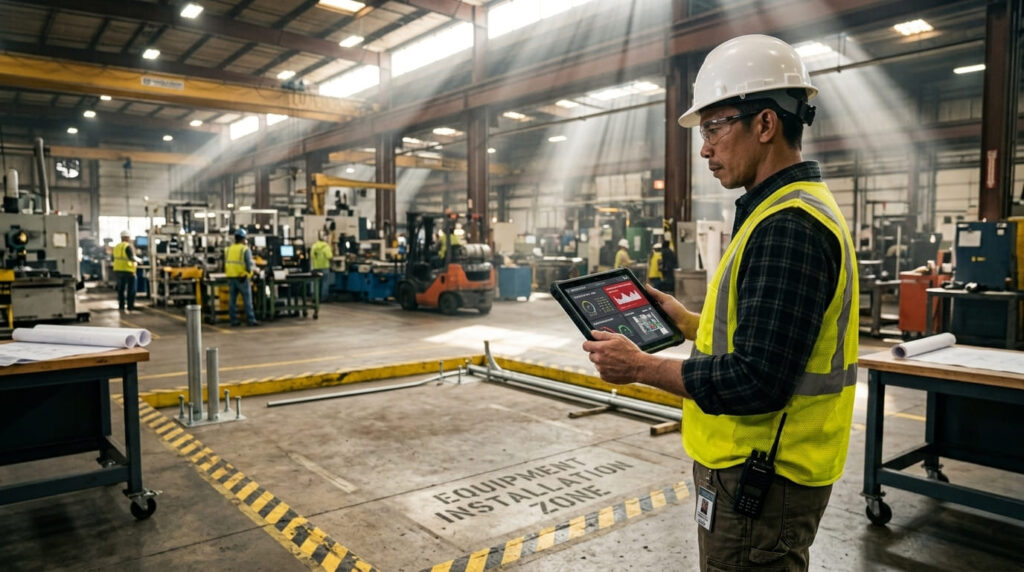
This is the step most startup operations skip, and it is the one that causes the most expensive mistakes. Before comparing any Avertec material-handling option or equipment category, you need three sets of site facts. Without them, every product recommendation in this article is directional at best.
Throughput, duty cycle and shift pattern
Count your pallet moves per shift and multiply by your number of shifts per day. As an illustration, a startup running one shift with 20 to 30 pallet moves has fundamentally different needs from one running two shifts with 80 moves. That difference determines whether a machine is used intermittently or continuously, which in turn determines what battery class is appropriate and which equipment tier is justified.
An electric stacker on a lead-acid battery is a solid single-shift solution. Lead-acid batteries typically require 8 to 10 hours to recharge fully, making them impractical for back-to-back shifts without a spare battery. Across two shifts without a spare battery or a lithium upgrade, the same machine may exhaust its charge well before the shift ends. Lithium batteries, by contrast, recharge in roughly one to three hours and support opportunity charging during breaks, making them the more practical choice for multi-shift operations. Confirm battery voltage, Ah rating, and shift compatibility with Avertec before ordering.
Aisle width, ceiling height and floor condition
Walkie stackers typically need working aisles of 2.4 to 2.8 metres. Sit-down counterbalance lift trucks need 3.5 to 4.0 metres. These are not preferences; they are non-negotiable site inputs. Ceiling height constrains your lift height selection, which affects your racking plan. Floor flatness matters more than most people realise: for electric stacker operation in racking aisles, a minimum floor flatness of FF 35 / FL 25 (tested to ASTM E1155) is the practical standard, with FF 40 / FL 30 recommended where racks are tall or aisles are long. Note that these are practical operational benchmarks rather than statutory requirements, but they reflect the real stability conditions that stacker manufacturers design to. A stacker rated to lift 4 metres on an uneven floor is a stability risk, not a storage solution.
Load weight, pallet size and load centre
The 500 mm load centre is the standard rating basis for most MHE. When a load extends beyond 600 mm from the fork face, the effective capacity of the truck reduces, a fact that suppliers explain in load-centre diagrams on their planning guidance. Ignoring this means you can legally purchase a machine that physically cannot carry your actual load safely. Measure your heaviest pallet, confirm your pallet type (open-bottom versus closed-bottom), and have those numbers ready before you speak to any supplier.
Avertec material-handling options under RM50,000: hand pallet trucks and electric pallet jacks
For startups moving goods between a loading dock and a ground-level storage area, this is where to start. The economics are straightforward, the maintenance is minimal, and the learning curve for operators is short.
When a hand pallet truck is enough
Avertec’s AC25 and AC30 series handle 2,500 to 3,000 kg with a working lift of approximately 200 mm and overall widths of 520 to 685 mm depending on fork configuration. For flat floors, short travel distances, and moderate daily frequency, a hand pallet truck covers the job without any capital outlay on electrics. If your factory receives two or three pallets per hour and the dock is twenty metres from storage, you do not need a powered solution yet.
Stepping up to an electric pallet jack
Avertec’s EPT15 and WEPT15-Li-V1 electric models carry 1,500 kg with the same 200 mm working height. The narrow version measures 550 mm wide with a 1,620 mm overall length and a 1,398 mm minimum turning radius. For operators covering longer distances across a factory floor, or managing consistent throughput across a full shift, an electric pallet truck reduces operator fatigue and increases travel speed, advantages that compound over a full working day. The trade-off is a higher unit cost, battery management requirements, and space for a charger. For single-shift operations, a lead-acid battery charged overnight is usually adequate. For two-shift operations, a lithium model becomes the more practical choice: full charges take roughly one to three hours, and opportunity charging during breaks keeps the truck running without battery swaps.
Trolleys as a budget complement
Industrial platform trolleys and two-wheel hand trucks handle lighter, irregular loads that pallets cannot accommodate. A 300-kg steel platform trolley with 100 to 125 mm castors and a non-slip deck fills real gaps in a startup workflow for very little cost. They complement rather than replace pallet-handling equipment, and they are consistently useful at assembly stations, packing benches, and goods-receive areas where a pallet truck would be oversized or impractical.
Electric stackers and lift tables: adding vertical reach without a full forklift
This is where most startup factories concentrate their MHE spend. An electric stacker unlocks vertical storage, multiplying your usable space without expanding your factory footprint. The key is matching the right model to your racking plan and pallet type before you order.
Matching stacker capacity to your racking plan
Avertec’s ES12 family, rated at 1,200 kg with lift heights from 2.0 to 4.0 metres, suits intermittent pallet stacking in low-to-mid rack configurations. The ES14 at 1,400 kg and the ES16 at 1,600 kg, with lifts reaching approximately 5.8 metres depending on mast configuration, step up for heavier-duty loading, container work, and high-rack environments. Both the ES14 and ES16 use 280 Ah lead-acid batteries; however, Avertec does not publish standardised duty-cycle hour ratings on its product pages, so confirm shift compatibility directly with Avertec before ordering rather than estimating from Ah rating alone.
Straddle-leg versus standard stacker for your pallet type
Standard stackers work with open-bottom pallets and need aisles of approximately 2.4 to 2.8 metres. Straddle-leg stackers can handle closed-bottom pallets, but their outrigger legs require slightly wider aisles, around 2.6 to 3.0 metres. Getting pallet type wrong at the procurement stage means the stacker physically cannot pick your load. Confirm your pallet type, and let that drive the stacker configuration discussion.
Lift tables for ergonomic workstation loading
Scissor lift tables serve a different purpose from stackers: they bring the load to the operator rather than lifting it into racking. For assembly lines, packing stations, or goods-receive benches, a lift table eliminates repetitive bending and reduces cumulative injury risk at fixed workstations. The use case is specific, fixed workstation, low travel distance, consistent load weight, but within those parameters, a lift table is one of the most cost-effective ergonomic investments available within a startup budget.
Electric lift trucks: when your throughput genuinely demands more
Be honest about this category upfront: a new electric lift truck will likely consume a substantial portion of your RM50,000 budget on its own, possibly all of it, depending on capacity and specification. This section is about knowing when you actually need one, and how to access the capability without exhausting your capital.
What an electric lift truck adds over a stacker
Counterbalance electric lift trucks handle heavier loads, typically 1.5 to 3.0 tonnes and above, travel faster, and can operate on uneven surfaces or outdoors where pedestrian stackers are unsuitable. The space requirement is significant: sit-down counterbalance trucks need 3.5 to 4.0 metres of working aisle, while stand-up models need roughly 3.0 to 3.5 metres. If your factory aisles cannot accommodate that, a stacker is the right call regardless of load weight. Do not try to make a forklift fit a space designed for a stacker.
Battery, shift planning and DOSH compliance
Electric lift trucks require thoughtful battery planning for multi-shift use. Lithium battery models, including Avertec’s CATL-equipped HELI range, support opportunity charging between shifts; lead-acid models generally cannot. DOSH/JKKP registration and periodic inspection apply to power-driven lifting machinery, and electric stackers and lift trucks fall within this regime regardless of rated capacity. The compliance process involves design verification, installation approval, and a valid Certificate of Fitness before operation, refer to the relevant DOSH/JKKP guidance for the statutory sequence. Factor registration, periodic inspection, and operator certification costs into your total budget from the start; these are not optional extras.
When to rent rather than buy new
For startups with uncertain throughput growth or seasonal demand peaks, renting an electric lift truck through Avertec’s rental programme avoids a large upfront capital commitment. Rental becomes the more attractive option when you expect to use the machine fewer than roughly half your working days. Avertec offers both short-term and long-term rental across pallet trucks, electric stackers, and forklifts, which means you can access the right capacity for a specific project without locking capital into an asset that sits idle between peaks.
Structuring your RM50,000: new, rental, pre-owned or a hybrid fleet
The goal here is not to spend the full RM50,000 on one machine. The goal is to build a fleet configuration that covers your daily workflows reliably, without overcommitting capital to equipment that runs two hours a week.
When buying new makes sense
New equipment through Avertec carries a 12-month warranty on manufacturing defects, access to genuine spare parts, and warranty-preserving servicing from Avertec’s own technicians. Avertec’s service network spans a head office and service centre in Klang (Selangor), offices in Johor Bahru and Simpang Ampat (Penang), and more than 10 mobile technicians covering Peninsular Malaysia. For equipment that will run heavily and consistently every shift, buying new protects against unexpected repair costs early in the asset’s life and keeps warranty coverage intact.
Rental as a capital-light alternative
Medium-term rental contracts, typically several months to 12 months, often suit startup factories bridging from a launch phase to a stable operation. Indicative monthly rates for electric stackers in the 1,200 to 1,600 kg range run roughly RM1,200 to RM1,500 in the Malaysian market. Final rates vary by duration, specification, lift height, and contract inclusions, so treat these figures as a planning reference rather than a firm price. Before signing, confirm minimum hire periods, delivery charges, maintenance responsibility, breakdown response times, and early-return penalties in writing. A low monthly rate that excludes breakdown cover is not a bargain if your machine is down for a week waiting for a technician.
Pre-owned equipment: what to verify before you commit
Pre-owned MHE can extend your RM50,000 meaningfully, but condition inspection is non-negotiable. At minimum, verify the following before committing:
- Structural integrity across the chassis, mast, forks, and welds
- Battery manufacture date and a capacity test
- Hydraulic condition and leak-free operation
- Hour-meter readings cross-checked against ECU records
- Whether the unit can obtain or transfer the required DOSH/JKKP Certificate of Fitness
A low purchase price is not economical if the machine needs a battery overhaul, fails inspection, or lacks local parts support. Engage an independent technician for any higher-value pre-owned unit, and make the purchase conditional on a satisfactory inspection report.
Building a hybrid fleet
For most Malaysian startup factories, the most practical outcome is a combination: own the equipment that runs every day, typically a hand or electric pallet truck and possibly a stacker, and rent specialist or high-cost machines when the project demands them. This approach spreads risk, preserves capital, and avoids locking your entire budget into a single asset whose utilisation turns out to be lower than projected. A basic hybrid fleet of pallet trucks and a stacker, for instance, can be assembled within a RM50,000 ceiling provided your site constraints are compatible.
Choosing between new, rental and pre-owned Avertec options: what to prepare before you request a quote
A quote is only as accurate as the inputs you provide. The more precise your site details, the more reliable the recommendation and the fewer surprises after delivery.
The site and operational details Avertec will need
Gather the following before making contact:
- Factory floor plan with aisle measurements
- Pallet type and dimensions
- Maximum load weight per pallet
- Ceiling height at the racking point
- Shift pattern and estimated pallet moves per shift
- Floor surface type and condition
- Any ramp or dock requirements
- DOSH/JKKP registration status of any existing equipment
Having these details ready shortens the quoting process and removes the guesswork from model selection.
Why a site survey matters more than a price list
General price statements for MHE are unreliable because configurations, accessories, battery types, mast heights, and site-specific requirements all affect the final figure. Two ES16 stackers with different mast heights and battery specifications can be priced very differently even though they share a model family name. Request a formal, itemised quote and, where the project justifies it, a site survey so Avertec can confirm aisle clearance, floor suitability, and the correct model specification before any purchase decision is made. That is the only number worth acting on.
Start with your site, not with the catalogue
RM50,000 can be a workable budget for a Malaysian startup factory, provided equipment selection follows site reality rather than catalogue browsing. A hand or electric pallet truck handles ground-level movement efficiently. An electric stacker unlocks vertical storage within practical aisle constraints. Lift tables improve ergonomics at fixed workstations for relatively modest cost. Electric lift trucks enter the picture when throughput genuinely demands them, and rental or pre-owned options make them accessible without consuming the entire budget.
Avertec Sdn Bhd, as a direct importer and distributor with rental, pre-owned, and after-sales service capability across Peninsular Malaysia, is positioned to support each of these decisions with a recommendation that reflects your actual site and operational requirements. The after-sales infrastructure, mobile technicians at more than 10 locations across Peninsular Malaysia, genuine spare parts, and preventive maintenance programmes, is part of the total cost calculation for any startup without an in-house maintenance team.
Gather your site dimensions, pallet specifications, shift pattern, and throughput numbers. Then request a personalised Avertec material-handling quote and site survey for your RM50,000 budget, that conversation, grounded in real inputs, will do more for your procurement decision than any general guide can, including this one.